
Purpose and scope
Do you want to expand the number of channels where your products are displayed? WebShop's integration with Google Shopping provides the functionality to do just that. This integration syncs your product catalog with Google Merchant Center. Once synced, your store’s products can be included in Google’s free listings and promoted using Smart Shopping campaigns.
According to Google Help, Google Shopping1 is:
-
Powerful: uses Google's search technology to locate your products and provides a link to your WebShop, allowing your customers to easily place an order,
-
Comprehensive: includes any product from your product catalog that you wish to showcase and
-
Fast: results are displayed very quickly after your customer enters their search term.
Our built-in configuration tool guides you through creating a link between Digital Commerce and Google Merchant Center (GMC), enabling you to use Google Shopping campaign ads with direct product links in WebShop.
The feature guide describes what and how to use our built-in configuration tool to configure this feature.
This feature is only available as part of the Digital Marketing SmartPack. Contact our sales team for more information.
Assumptions
-
Any costs associated with Google Merchant Center are your responsibility.
Benefits
Key benefits of using Google Shopping ad campaigns include increasing your return on investment by improving SEO, boosting your product's Google search results, and improving your Click Through Rate (CTR).
Integrating Google Shopping with your WebShop has additional benefits:
-
Provides an automatic feed of your products between your ERP and your Google Merchant Center via Digital Commerce Platform. This means you can manage your product catalog in your ERP, and be sure that any updates you make are regularly and automatically updated to Google Shopping.
-
Streamlines the ordering process. Once a customer selects to purchase a product, they are seamlessly directed to WebShop to place their order; by default, the order is placed in real time into your ERP.
-
Shares up-to-date, accurate, real-time stock and pricing data directly from your ERP via our platform.
-
Use it as an automatic feed via WebShop to other systems, such as MailChimp or Klaviyo.
Introducing terms and concepts used in this article
|
Term |
Definition |
|---|---|
|
Application Programming Interface |
(API), which is an interface that allows two different computer systems interact with each other. It consists of a number of rules (also known as endpoints) that request data from the other system and receive and process responses from that system. |
|
API key |
a code used to identify and authenticate an application. |
|
Enterprise resource platform (ERP) |
(ERP), a collection of your critical business operating systems, such as product, stock levels, financial, customers, suppliers and so on that run on the same platform. |
|
(GMC), a service offered by Google that allows you to add your product information to Google. Once this information is uploaded to Google, the service makes it available to your customers when they search for your products using Google. |
|
|
Product feed |
a structured description of your products that can be shared with other channels. |
|
Search engine optimization |
(SEO), a method of attracting more organic traffic to your website (in this case, WebShop) by making it appear higher on search engine results pages. |
|
Uniform resource locator |
(URL), the address of a website. |
Fitting it all together
Once you’ve purchased the Digital Marketing SmartPack, you can download and install the Google Merchant Center (GMC) app, found in our App Store in the Management Interface, to establish a connection between Experlogix Digital Commerce Platform and Google Merchant Center. Activating the Google Merchant Center app consists of authorizing the connection between the two systems and contacting our support team to complete the setup. Read How do I configure and manage Google Merchant Center? for a step-by-step guide.
Once the connection between the Experlogix Digital Commerce Platform and Google Merchant Center is established, you can configure a product feed. The product feed exports your product catalog and imports it into Google Merchant Center. This allows you to run Google Shopping Campaigns to increase revenue easily and efficiently while maintaining only one product catalog. You can further segment your product feed using custom labels and specifying the Google product category for each product.
Read this if you are a customer with an existing integration between Experlogix Digital Commerce and Google Shopping
This content is intended only for customers with an existing integration between Experlogix Digital Commerce and Google Shopping.
Read How do I configure and manage Google Merchant Center? for our updated integration process.
We recommend that if you have an existing integration, please update your integration using our new Google Merchant App before August 2026.
This is because Google will no longer support the Content API for Google Shopping from 18th August 2026; we had used this API to integrate Experlogix Digital Commerce and Google Shopping.
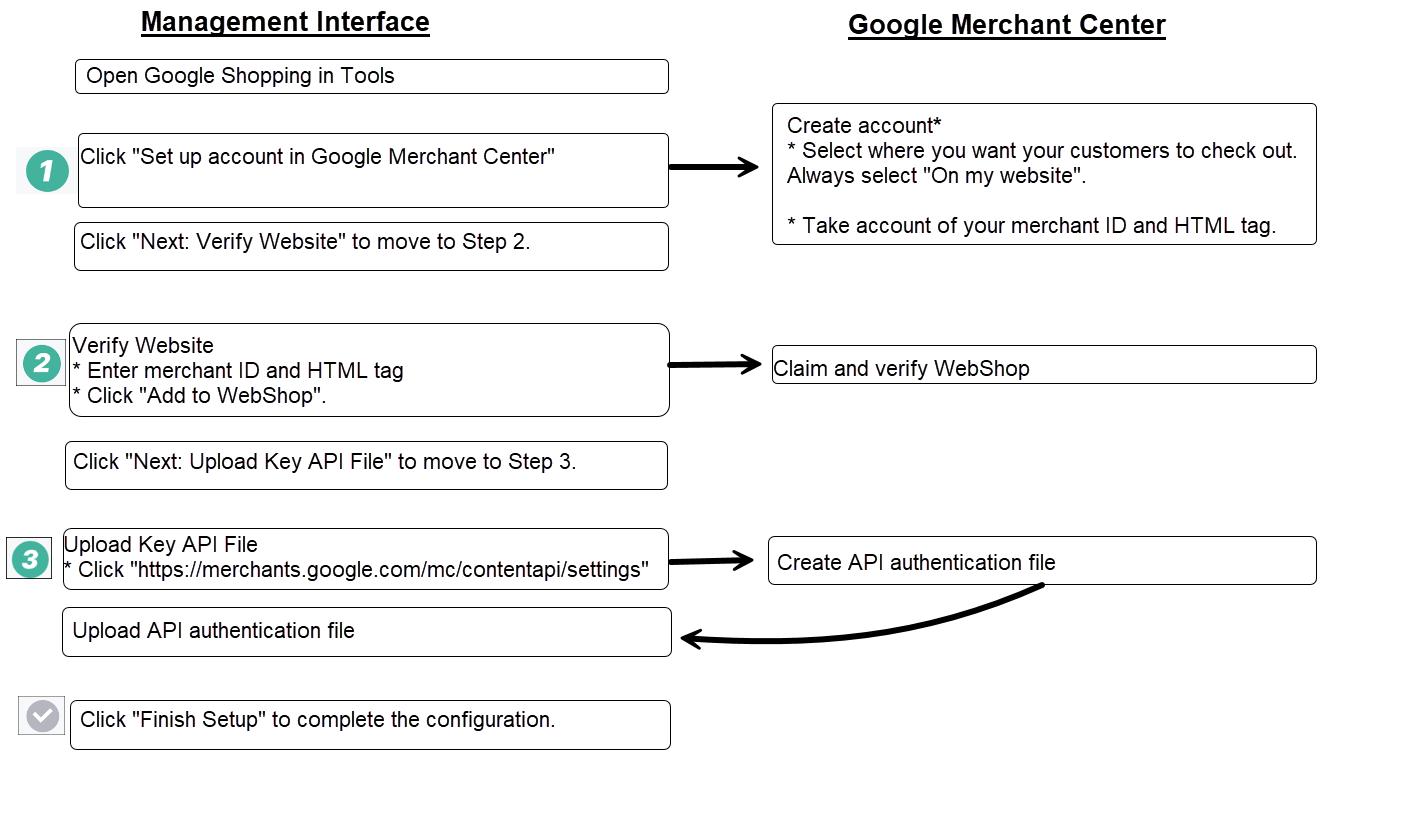
Our built-in configuration tool in the Management Interface guides you through a 4-step process that establishes a connection between the Digital Commerce Platform and the Google Merchant Center. Then you can configure a product feed. The product feed is run regularly and automatically, allowing you to manage your product catalogue in your ERP, knowing that any product updates will be synced with Google Merchant Center.
Here's a visual on what is required for you to integrate Digital Commerce with Google Merchant Center:
Google Merchant Center (GMC) has defined a product taxonomy (see here2 for the latest version). Products listed in your WebShop are mapped to the GMC product taxonomy. However, a product can be listed in numerous WebShop categories (see Using the Product in Category Editor for more information). By default, the primary category for each product listed in the WebShop catalog is contained in Category Tree 1. Should a product be listed in more than one category in WebShop, the primary category tree is the one mapped to the corresponding GMC category. Of course, you can change the default category mappings to GMC categories that suit your business needs using the features in the Management Interface. In particular, to override the default mapping for a single product or category, use Edit Product or Edit Category for that product or category (see here for more information). To override default mappings for multiple products or categories, use either the product import/export spreadsheet or the category import/export spreadsheet features (see here for more information).
Your Google Shopping product feed has a scheduled export that runs regularly to keep your GMC catalog accurate and up to date. Any changes that you make to GMC category mappings are automatically included in your scheduled Google Shopping product feed export.
Example
In WebShop, the product “Screen Protector for iPhone 11 and iPhone” has been included in two categories:
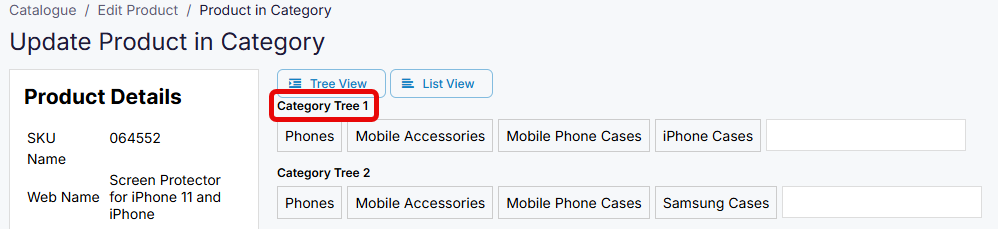
By default, when this product is mapped to a GMC category, only the entry in Category Tree 1 is used to determine which GMC category to map it to.
More information
Set up
This feature is only available as part of the Digital Marketing SmartPack. Contact our sales team for more information.
Contact our support team to enable the Google Merchant Center app once you have purchased the Digital Marketing SmartPack. Then follow the steps in the app to set up the integration between Experlogix Digital Commerce and Google Merchant Center.
Read How do I configure and manage Google Merchant Center? for a step-by-step guide to using the Google Merchant Center app.
Use
The Google Shopping product feed is scheduled and automatically uploads from Experlogix Digital Platform to Google Merchant Center.
Discover how to override the default category mappings between WebShop and Google Merchant Center or find out how to set up custom labels in Google Merchant Center to further segment your product feed to suit your business needs.
Related content
-
How to set up an integration between Digital Commerce and Google Shopping - Deprecated.
-
Why is the connection between WebShop and the Google Shopping merchant account not established correctly? - Deprecated.
References
The listed references are external sites over which Experlogix has no control.
2 Google Product Taxonomy Version: 2021-09-21